|
|
| |
|
'Everything
she writes is worth reading' The
Times |
|
| |
|
|
THE SELFISH GIANT
Garsington Opera Company
Music by John BARBER
Words by Jessica Duchen, after Oscar Wilde
29 July 2021
|
|
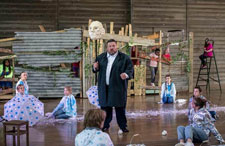
Well, the accordion player was pinged, but Garsington Youth Opera was otherwise spared by the pingdemic gods for the premiere of The Selfish Giant. Not that it was a simple task to stage this vibrant new opera. Think 75 children and teenagers, often singing in masks, only ever rehearsing in groups of 15, standing in two-metre socially distanced squares taped on stage. Then add the over-18s beaming in via Zoom from all round the country to sing their parts. Mozart had it easy.
I mention all this not as special pleading for The Selfish Giant, but because the performance bears very little trace of its piecemeal preparation. Even outside a pandemic, it would have been a worthwhile achievement. As it is, this opera based on an Oscar Wilde short story seems like a hopeful parable for our times: in essence the tale of a group of children who are told by a terrifying giant that they can’t play any more. After winter, hardships and soul-searching, eventually spring and the children return to their beloved garden…
The composer John Barber and librettist Jessica Duchen have written an opera to last, balancing clarity and lyricism, avoiding cliché. Garsington only gives one performance, but The Selfish Giant should surely have an afterlife.
|
Rebecca Francks, The Times 
|
|
Wilde’s tale of young people cruelly deprived of the giant’s garden has a special resonance in our pandemic times … The giant – a distinguished performance from Matthew Stiff – is enraged at the intrusion, and banishes the children from his garden, ushering in the winter children with silver clothing, umbrellas and crumpled paper ‘snow’. The Linnet (Barbara Cole Walton, soaring in a sky-scraping vocal range) and the mysterious Child (an endearing Barnaby Scholes) awaken the giant to the futility of his ways. After all, as Duchen’s appealing libretto has it, “this land belongs to everyone” … Barber’s sparkling score, with liberal lashings of Janáček and John Adams, propels the action forward.
|
The Stage, |
|
I have just watched John Barber’s youth opera The Selfish Giant at Garsington. And I can’t remember when I last heard a new opera – for any age-group – which gave me such unalloyed pleasure… The story by Oscar Wilde on which the opera is based has been skilfully adapted by the librettist Jessica Duchen. Engaging from the first bar onwards, the score has no trace of the awkward pretension which mars most new ‘grown-up’ operas; it is at once tonal and arrestingly original, full of atmosphere, and allowing the performers ample scope to project emotion and character.
|
Michael Church |
|
| |
|
| |
|
|
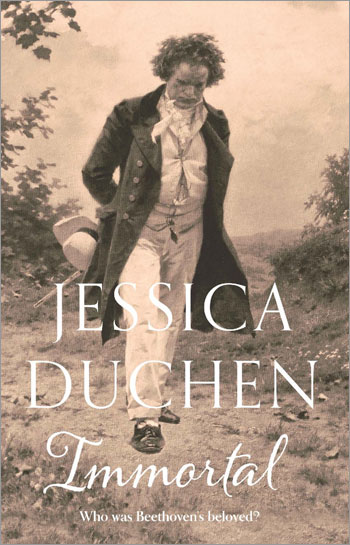
IMMORTAL
Unbound, 2020
£10.99 p/b, £5.99 e-book
|
|
“IMMORTAL is a revelation, offering the ideal blend of historic exactitude and a book you simply won’t want to put down.”
|
Daniel Hope, violinist, president of the Beethoven-Haus, Bonn
|
|
The perfect companion for this landmark Beethoven anniversary year. Jessica’s writing is, as always, deeply knowledgeable, emanating from a profound understanding of her material. This new book brings the human, vulnerable side of Beethoven into focus for our 21st Century audience.”
|
Marin Alsop, conductor |
|
From its first, dazzlingly-rendered pages IMMORTAL pulls you into a vanished world and an utterly compelling love story – at its centre, one of music’s greatest and most enduring mysteries. Few authors understand better than Jessica Duchen the way music can change the course of a life; and few writers make that music leap more vividly off the page. If you’ve ever wondered what Ludwig van Beethoven was like as a man, here he is, painted as if from life: inspiring, infuriating, and intensely, unapologetically real. Because for all her understanding of art and character, and her brilliantly-described evocations of early 19th century Vienna in all its splendour and squalor, Duchen never forgets that at the core of all great music – and all great stories – beats a human heart.
|
Richard Bratby, music critic for Gramophone and The Spectator |
|
“…Jessica Duchen, best known as one of our leading music critics, has investigated the whole [Immortal Beloved] story…and has imaginatively used the material for a novel, which is largely based on historically documented events and personalities. In the course of a vivid narrative, Duchen introduces many people whom Beethoven knew and describes his latest compositions, all of this among countless venues in Vienna and across central Europe… Duchen (or Tesi) touches on everything from the most broadly historical to the most private and intimate.”
|
| Daniel Snowman, The JC |
|
|
| |
|
|
|
SILVER BIRCH
Garsington Opera Company
Music by Roxanna Panufnik
Words by Jessica Duchen
Friday, Saturday, Sunday, 28, 29, 30 July 2017
|
|
“Roxanna Panufnik’s Silver Birch embodies the power of music to transform lives and communicate a profound, universal message.
Jessica Duchen’s libretto seamlessly blends letters documenting the experiences of serving soldiers in Iraq with the poetry and diaries of soldier Siegfried Sassoon (1886-1967) to convey a timeless picture of the individual cost of war without ignoring its related courage and comradeship.
Panufnik and Duchen’s achievement is to synthesise personal and poetic experiences, often harrowing and disturbing, into a work of beauty and hope.”
|
|
|
“Jessica Duchen’s libretto is powerful and poetic and Roxanna Panufnik’s music busy and imaginative. I liked her Gershwin-like harmonic richness and the idle Eastern melodic twists she introduced in the war-zone acts.
Whether it’s epic crowd scenes or anguished soliloquies, however, all are folded into a nonstop hour-long drama that is cinematic in its scope and fluidity.”
|
Richard Morrison, The Times,  |
|
“Roxanna Panufnik has chosen to describe her new creation Silver Birch as a people’s, rather than a community, opera in order to emphasise the extent to which it is intended to transform people’s lives. It is a noble aim and one that seems to be very much fulfilled. It is obvious that the work has had an enormous impact...
Panufnik’s music is both strong and accessible. It is designed to stretch the singers rather than patronise them, and yet is set up so that intriguing effects can be generated from music that is manageable for large groups to execute to a high standard.
Jessica Duchen’s libretto is highly effective, and includes poetry by Sassoon alongside popular songs.
…a work that it is safe to say is having an impact on performers and audiences alike, and which stands as one of the very best examples of this type of opera.”
|
|
|
“For Panufnik, this very professional piece of work should be a useful stepping stone to something bigger. For its cohorts of community singers and dancers, well drilled by conductor Douglas Boyd, this was a real achievement in itself.” |
Richard Fairman, The Financial Times, |
|
“… A remarkable event with a vast community cast.
There is a real sense of vision in this coming together, as clear in the unstoppable energy of the performers as it is in the excellence of the stagecraft displayed in Karen Gillingham’s complex production.
Verdict: Karen Gillingham’s staging of Roxanna Panufnik’s community opera is a remarkable event.”
|
The Stage,
|
|
“This was undoubtedly the most uplifting and moving evening I’ve spent in the theatre this year.
The juxtaposition of the children back home playing and taunting in the playground and the horror of the front line – one of the most effective on-stage evocations of war I’ve ever seen was almost unbearably poignant. Roxanna Panufnik’s fine music is full of mood change too.
I really hope that this fine work does not begin and end at Wormsley with three Garsington Opera performances in the heart of idyllic Oxfordshire countryside. It deserves many more outings – soon.”
|
Susan Elkin, Sardines Magazine |
|
While the narrative line brings together the realities of the trauma of war - an excellent libretto from Jessica Duchen - it moves seamlessly between Siegfried Sassoon and the war in Iraq. Jack’s story is reflected in the massed reactions of the general public, the army itself and a large body of school children. Jessica Duchen does not flinch from the painful realities of the effects of war. Jack is genuinely traumatised by his time under fire and his emotional life - fragile at the best of times - is destroyed…
Roxanna Panufnik writes bold passionate choruses, often easily lyrical but never simplistic or overtly popular. … This was a magnificent undertaking for all concerned. |
Brian Hick, Musical Opinion |
|
| |
| |
|
|
|
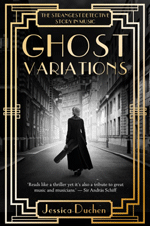
GHOST VARIATIONS
Unbound, 2016
£9.99 p/b, £3.99 e-bo
MY BEST READ
JOHN SUCHET
Ghost Variations
Jessica Duchen, Unbound £3.99 (ebook)
A thrilling read set in Thirties London and Germany. It’s the true story of Robert Schumann’s lost violin concerto, and the race between a Hungarian violinist and the Third Reich to find and perform the work.
as featured in -- The Daily Mail, Best Books of the Year 2016
.................................................................................................... |
Haunted by the past
A ouija board, a long-lost manuscript, a free-spirited heroine and a continent in the grip of political upheaval: Jessica Duchen’s gripping new novel, Ghost Variations, explores a truly intriguing episode in musicological history…
Neatly subtitled ‘The Strangest Detective Story in Music’, the novel spins a gripping yarn, but also draws haunting and all-too-potent parallels between contemporary society and 1930s Britain. Duchen skilfully charts the poisonous rise of the far right and a deepening mistrust of “foreigners”, while also unpicking the thorny gender politics of the performing arts with fierce aplomb… the warmth that Duchen brings to her characterisation of d’Arányi as a brave yet guileless female musician boldly taking on the male establishment makes for a stirring read and propels the narrative to its moving and uplifting close.
-- BBC Music Magazine, Books Choice of the Month, January 2016
|
|
"Schumann's wonderful violin concerto has a tragic history unlike any other piece of music. In this splendid new novel Jessica Duchen manages to find the fine balance between facts and fiction. Her book reads like a thriller, yet it's also a tribute to great music and musicians"
– Sir András Schiff |
|
Hugely atmospheric
This is much more than 'just' a musical mystery. Duchen has immersed herself, not just in the music, but in the entire musical world of the 1930s. Jelly is a marvellous character, but it isn't only about her passions and travails. The level of research employed in bringing to life some fabled characters is inspiring— Myra Hess positively romps through her scenes, Sir Adrian Boult conveys dry conviction, Donald Tovey comforts, Goebbels terrifies.
The period itself is exquisitely evoked, from the Chinese silks to the teas spread out on the lawn, from the rather privileged expat London musical elite to the late 1930s forebodings of history yet to come.This is a hugely atmospheric and thought-provoking book featuring fascinating characters, written by someone as fully in command of her research as of her imagination. It evokes a period pregnant with both promise and menace — and a musical world itself lost forever.
-- Alice McVeigh, Music & Vision Daily
|
|
Musical quest from ouija board to rostrum
SCHUMANN’S LOST concerto and a virtuoso femme fatale keep you gripped and guessing in Ghost Variations. Set in 1930s London, this musical mystery by Jessica Duchen strikes a hot-blooded tune with grace notes from beyond the grave. The story centres on Jelly d’Aranyi, Hungarian, part-Jewish violinist and siren muse of Bartok, Ravel and Elgar.
Pressed to participate in a Ouija board sitting, Jelly receives a message purportedly from Robert Schumann’s spirit, entreating her to find his unknown violin concerto in D minor.
Jelly is shaken by and sceptical of her own eerie experience. But pressure mounts from her sister, the spirit-sensitive Adila and a titled family friend.
Jelly (pronounced Yeli) is no longer dazzling audiences as she once did, bowing the Tzigane rhapsody dedicated to her by Ravel. Two of her lovers are dead, a third, and a possible fourth only waiting in the wings. She is troubled by Europe’s tension. So the lure of playing detective and of reviving her glory days by performing the piece as a world first, sets Jelly off like a conductor’s nod.
There ensues an impassioned quest that will engage the ears of Chamberlain, Hitler and a scornfully disbelieving British press.
Ghost Variations reads like a bohemian thriller freshly imagined by Duchen, herself a pianist and musical scholar. It is, however a whole lot stranger than fiction: Duchen’s novel is inspired by the real-life events surrounding the exotic Jelly d’Aranyi, to whom Vaughan Williams and Holst also dedicated works. Jelly did indeed spark the search for Schumann’s concerto, which has its own heady history. The D Minor piece was not exactly lost, but lay unpublished and unplayed for 80 years in the Prussian State library: Clara Schumann, the composer’s widow suppressed it on the grounds that it betrayed the composer’s incipient instability — he later died, delusional in an asylum.
Jelly raises Schumann’s profile at the key moment when Goebbels, having banned the concerto by the baptised Jew Felix Mendelssohn, can resurrect echt German music as propaganda. Duchen has all this remarkably obscure material at her fingertips, fleshing it out with a strong sense of social history and the
Robert Schumann fashionable refinements of this prewar age. Pianist Myra Hess makes a cameo appearance in a cloud of cigarette smoke, evoking an arty feminism that ranks music above marriage. Norman Hartnell gowns, tango shoes, naturist beaches and the ménage a trois help to conjure this period of “psychical” enthusiasm for darkened rooms and the question: “Is anybody there?”
The response from Jelly’s own world, never mind the next, was that she was far from alone — just one of a temperamental trio claiming first rights to the Schumann. While she insisted the privilege was exclusively hers, Germany pushed forward their own Georg Kulenkampff to take first bow. The young Menuhin jockeyed to win the concerto for his Carnegie Hall comeback after a year off. And music publisher, Schotts, stirred the situation with multiple agendas. Duchen’s orchestration of such intrigue merits great applause.
-- Madeleine Kingsley, The Jewish Chronicle
|
|
|
|
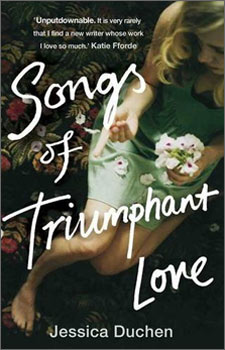
"SONGS OF TRIUMPHANT LOVE is an enthralling novel: I couldn't stop reading. I got deeper and deeper into the very real world Jessica Duchen has created and just had to find out how it would unravel. Jessica writes with an unpredictable and original voice and a dazzling perceptiveness, and I was hooked from the first page. A sensational achievement." |
JOANNA LUMLEY |
|
“Jessica Duchen writes about families, the arts and their sometimes devastating combination with such skill and passion that her books are unputdownable. It is very rarely that I find a new writer whose work I love so much.” |
KATIE FFORDE |
|
|
 To order PAPERBACK
click picture
To
order HARDBACK
CLICK HERE
 read more on the LEP
(Lancashire Evening Post)
website |
| SONGS OF TRIUMPHANT LOVE |
Hodder & Stoughton, 2009
£19.99 hardback - £7.99 paperback
Jessica Duchen has music in her soul ... and she uses the intrinsic harmonies that so patently instruct her own life as the inspiration for her clever and compassionate novels.
Her latest and startlingly original book about the healing powers of music revolves around Russian author Ivan Turgenev's short story The Song of Triumphant Love.
Turgenev fell hopelessly in love with the 19th century opera singer Pauline Viardot who famously quit the stage at an early age because she lost her beautiful singing voice.
Taking the relationship between Turgenev and Viardot as her central theme, Duchen weaves the strands of their real lives into the fictional but parallel tale of an opera singer facing a career-ending illness....
Duchen's twin passions are music and writing and in Songs of Triumphant Love they work together in perfect harmony.
Terri is a masterful creation ... a larger-than-life diva with very human flaws but who has the guts and determination to take the world and the stage by storm.
And her story is not just a tale of universal human emotion but a symphony to the offbeat melodies of modern life.
Pam Norfolk (Lancashire Evening Post) 14.7.2009
|
|
 read more on the
bookbag website
|
| SONGS OF TRIUMPHANT LOVE |
Hodder & Stoughton, 2009
£19.99 hardback - £7.99 paperback
There are some books you neither want nor are able to put down, and this is one of them. From the moment I cracked the spine I was drawn in by the lives of the characters… It is indeed a Song of triumphant love, and when that love triumphs, it is truly a sight to behold. The book borrows some ideas from its namesake, Turgenev's 1881 work The Song of Triumphant Love but it's more a case of using it as a muse than of even a hint of plagiarism. Duchen's book is an entirely new story rather than a rehashing of an original, and is a masterpiece in its own right.
…The characters are beautifully described, and flawed in a wonderfully real way…an exquisite, tightly woven tale of pleasure and pain, hope and suffering, optimism and defeat…solid, juicy, sink your teeth into writing. It's a book that takes you on an adventure you never want to end, makes you friends with characters you never want to leave. It was simply a joy to read.
Zoe Page, The Bookbag
|
|
|
"A touching story of family relationships" - Woman magazine |
| |
|
|
"A story about a mother and daughter, men and music. Throw in a long buried secret and a dose of love and intrigue and you have the perfect recipe for a great summer read." - The Glasgow Daily Record |
|
|
|
To order PAPERBACK
click picture
To
order HARDBACK
CLICK HERE |
|
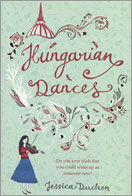
| HUNGARIAN DANCES |
Hodder & Stoughton, 2008
£19.99 hardback - £7.99 paperback
When disaster befalls her best friend, Karina feels compelled to question the very foundations of her existence. Born in Britain to Hungarian parents, wife to a very English husband and mother of a young son descended on one side from the lord of the manor and on the other from a dynasty of wandering minstrels, Karina feels she belongs in neither one world nor the other. But Rohan, a fellow violinist and fan of her own grandmother, encourages her to delve into her Hungarian family background and her Gypsy ancestry. Her discoveries will change her life forever.
Past and present collide in the intertwining stories of Karina and her grandmother, the celebrated violinist Mimi Rácz. Love and loss, displacement and continuity mingle in a moving panorama that spans eighty years and is permeated by the family’s one constant: the sound of the violin.
Hungarian Dances is a love story, a mystery and a tale of extraordinary personal transformation.
Gavin Esler writes: "A great love story and mystery set in – among other things – the world of Hungarian gypsies and passionate musicians. Duchen has a rare talent which is increasingly being recognised."
|
|
|
Read the first three pages of "Hungarian Dances " here |
|
| |
|
 |
...click on logo to read Jessica's interview with Hungarian national paper Nepszabadsag about "Hungarian Dances". (in Hungarian) |
|
|
 |
* Classic FM Magazine, September 2008: Writer's Passions *
Read Jessica's account of how the violin inspired /Hungarian Dances/...
(PDF file 700 kb) |
|
|
 |
Guardian - OnLine, 12 August 2008: Jessica's top ten literary Gypsies
Read Jessica's selection of the Top Ten Gypsies in Literature on the Guardian Unlimited website here . |
|
|
|
South China Morning Post , September 2008 |
'In Jessica Duchen's third novel, music is everywhere, evoked tenderly as sound and memory... I suggest you give Hungarian Dances a whirl.'
|
|
|
|
The Independent, 08 August 2008 |
Like a stuffed palacsinta pancake, Duchen's novel of music and memory bulges with fruity treats. A rail crash in London forces Hungarian-descended violinist Karina, married to a stuffed-shirt lawyer, to rethink her life.
Enter the tale of grandma Mimi, also a violinist, and her Gypsy family, as Budapest suffers under the Nazi and Stalinist yokes. Karina, meanwhile, recovers her roots and her rhythms in a saga whose passion for music, Hungary and history sings out on every page.
|
|
|
|
|
BBC Music Magazine, Proms Issue |
| Amo, amas, Amati! … Jessica Duchen could scarcely resist turning to love-and-the-violin for the subject of her third and most substantial novel to date…
In rooting for her past Karina discovers a network of unsettling displacements and dislocations – of human beings, emotions and musical instruments. Two love affairs, past and present, hurtle towards each other on two time-lines; and, as ever, Duchen shows herself more than adept at handling shifting time-scales, structures and tenses.
This is a far more complex plot than that of her first two novels, and Duchen judges the accelerando and the ritardando of the narrative pace to a nicety. It really is difficult to put the book down.…
But it’s Duchen’s compassionate human observation which carries her through – this, in addition to some obviously diligent research on the Hungarian-Gypsy musical tradition and on Budapest past and present. Those inside the musical world will relish sentences such as ‘orchestras are full of sheep eating shit’ (wonder where she got that one from…); those outside it will marvel at its fragility and volatility. And everyone will be encouraged to ponder just how far the search to ‘find oneself’ is selfish, unselfish or, impossibly and painfully, in a timeless dislocation somewhere between the two.
|
|
|
 |
Classical Music Magazine, 10 May 2008 |
"Jessica Duchen’s two previous novels have established her very real pedigree as a writer blessed with a beguiling fluency and an entirely believable handling of 21st-century human dilemmas, set within a musical dimension…Mimi’s story provides a lengthy parallel story-line, interwoven with the present in a sensitive and convincing way....Duchen does the complexity of human relationships and dependencies very well indeed, not to mention the less than ideal compromises which are the stuff even of close human intercourse. The essentially musical matrix (including a cameo appearance from Bartók) will not bother a classical music enthusiast one jot, and hopefully will not deter the musically illiterate either. The human interest is strong enough. Amusingly, not least for the general reader, there is plenty of sharp-edged commentary on the UK’s creaking transport system – closely woven into the narrative, of course.The prose is as flowing and rhythmically satisfying as we have come to expect. Duchen regularly displays a really telling eye for a phrase such as …the reference to the outcome of a failed relationship: ‘Old love turned to stone by lawyers’. Helpfully, there is a guide to Hungarian pronunciation and also a bibliography with plenty of Hungarian historical leads. And we can also look forward to a forthcoming CD from fiddler Philippe Graffin featuring plenty of the music mentioned in the novel. All highly recommended."
|
|
|
|
|
|
| |
|
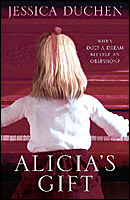
| ALICIA'S GIFT |
‘The devil in this book is in the detail, the accumulation of every detail that disables middle class life when the unexpected lands, in this case a musically gifted child. You turn the pages with a tremble, in case you crush the fragile family. Unbearably real.'
Yasmin Alibhai-Brown
15/03/2007 |
|
|
|
|
You
are invited to read the first three pages of "Alicia's Gift " here |
|
|
 |
BBC Music Direct September 2007 - Review by Barry Witherden |
|
Jessica Duchen’s latest novel concerns Guy and Kate, once talented musicians when students but neither of whom have pursued musical careers. Their long-awaited first baby, Victoria, is born prematurely and dies within days. Adrian, the second child, lost in their unhealed grief, is emotionally neglected from the start, but when Alicia arrives she is invested with the unbearable weight of maternal fears, hopes and expectations. Expected to live out the frustrated dreams of her mother and piano-teacher, both mourning dead daughters and still-born performing careers, Alicia is blessed (or cursed) with perfect pitch, the ability to play any piece by ear, and synaesthesia.
Duchen’s excellent first novel, Rites of Spring, peopled largely by self-centred, ill-intentioned characters, watched a family sliding towards disintegration. Here again, no one really listens to anyone else, but they mostly mean well, which makes the impending destruction all the more painful. Alicia and the kindred spirits she meets after becoming the BBC Young Musician of the Year rightly see music as an end in itself, but the adults tend to see it as a path to fame, fortune or sexual conquest.
As in Rites of Spring, Duchen demonstrates a gift for vividly sketching, with a few deft lines the environment in which the characters move as well as their internal emotional landscape, and again her compassion for her characters is persuasive. Near the end there are a couple of plot developments heavily signposted from about halfway through, that struck me as too neat, but they do contribute to the catharsis which she builds towards, and provides, so effectively.
|
 |
Barry
Witherden |
|
|
 |
Classic FM Magazine August 2007 - Review by Anna Britten |
|
If your child seems headed for a glorious career in the arts, how hard should you push her or him? Having explored a similar topic in last year's enjoyable Rites of Spring, pianist and music journalist Duchen considers the impact a prodigy can have on an average middle-class family in her second novel. The Buxton-based Bradleys boast at their core the pitch-perfect young pianist Alicia. As her fame grows so does the domestic pressure, and over the course of 15 years, all close to her see their lives turned upside down. Duchen throws adultery, bereavement, lesbianism, synaesthesia, first love and more into a plot with as many dramatic peaks and troughs as a Rachmaninov concerto. A beach read con brio.
|
|
 |
Music Teacher Magazine May 2007 - Review by Clare Stevens |
|
Duchen balances the conventions of the genre with the authority of a writer who really knows her subject. I felt I knew her characters intimately and was walking with them into their houses and offices, into concert halls and across the Derbyshire moors and dales. 'Alicia's Gift' is a wonderful read. But make sure you keep the Kleenex handy when you tackle it.
READ the full review (pdf file/1mb) |
|
| |
| To
order, click on Picture. | |
|
|
|
| RITES
OF SPRING | ‘Jessica
Duchen's debut novel is captivating, imaginative and fascinating. As a musician
and a mother, I recognized many of the scenarios and found the questions that
were posed very poignant, both from a musical and personal perspective. The pace
builds powerfully to a dramatic and ultimately very moving conclusion. Completely
gripping!’
Tasmin Little (from Hodder
Headline website)
27/12/2005 04:00:20 |
|
|
You
are invited to read the first three pages of
"Rites of Spring" here
| |
|
|
|
 |
Young Minds Magazine 85 |
"Many themes intermingle in the story: thwarted ambition, vanished dreams, broken promises, the competing demands of family and self. The outcome stresses compromise, along with the constant rebirth of hope...The novel should appeal to adults and teenagers and, in having a kind of happy ending, could for some light the way out of despair."
|
|
|
|
|
BBC
Music Magazine June 2006 |
...The novel accelerates towards
a traumatic crisis, and we urge Lisa on as she tries to rescue Liffy from her
own personal Erl-King. Duchen skilfully enlists our compassion and understanding,
and her not-inconsiderable achievement was to make me empathise, as well as sympathise,
with the central characters.
|
 | Barry
Witherden | | |
|
 |
Eve
Magazine, September 2006 |
'...an imaginative novel...with themes of miscommunication, perfectionism and adolescence.'
|
|
|
 |
Closer
Magazine |
‘Adam
and Sasha appear to have the perfect life - good jobs, a nice home, money and
three perfect children. But as their marriage begins to unravel, their ballet-crazy
daughter starts starving herself - and her parents are too preoccupied to notice.
A
haunting, heartbreaking novel.’
|
 |
| |
|
|
Inspired
by Stravinsky's The Rite of Spring, in which a young girl dances herself to death,
Jessica Duchen has crafted a riveting drama set within the arts world. The story
centres around 13-year-old Liffy, who, as her arty parents' marriage crumbles,
retreats into her imagination. Meanwhile, across town, her aunt struggles through
a tempestuous affair with a famous Russian pianist. The neatly-composed plot charges
to a climax as steadily as Ravel's Bolero, with Duchen capturing well the inner
world of the pubescent girl and the London classical music scene. For fans of
Joanna Trollope and Russian composers alike. | |
Anna Britten, Classic FM Magazine, June 2006 | |
|  .......
Rites of Spring draws on the image of a young girl dancing herself to death
in Stravinsky's ballet to explore the impulse towards anorexia common in so many
teenage girls today. .......
Rites of Spring draws on the image of a young girl dancing herself to death
in Stravinsky's ballet to explore the impulse towards anorexia common in so many
teenage girls today.
Duchen paints a vivid and utterly bleak picture
of modern family life, poignantly depicting Liffy's increased isolation as the
people around her become so preoccupied and alienated from one another that one
of the central characters, observing from a distance, "wonders how people
who are individually so bright, so intelligent, so nice, so creative, can collectively
paper over all their problems".
A sensitive and thought-provoking
novel that will resonate all the more for those with musical leanings..
| .Muso
- the Music Magazine that rewrites the score |
...................... |
| | | Rites
of Spring
How many of you still haven't read Jessica's Rites of Spring? I pre-ordered my
copy. I have never been so organised about anything in my life. Read
reviews and the first three pages here;
my review's below. You
can read Rites of Spring as a tale of a family's breakdown under modern pressure.
Its characters unfold intriguingly alongside a pacy plot and moments of real poetry.
Yet it isn't their familiar shopping at Waitrose, holidaying in Greece, or strolling
through Richmond Park that hold our attention. No aga-saga, this novel is about
the problems facing the human spirit – not just those who make it in the
end, but those who don't. Like
Duchen herself, jointly writer and musician, the novel spans the creative arts.
Its various artists (sensitive and introspective as they are) illuminate the crucial
focus on our souls. There is a world-famous concert pianist; a respectable music
academic; a talented artist who is airbrushing porn to support his family; a once
promising dancer who had to give it up when she got pregnant, but is none the
less carving out a good career for herself as a cultural commentator. None of
these characters lack talent or application - or even opportunity, middle-class
as they are - but they enjoy different levels of success. Most poignant of all
is thirteen year old Liffy, desparate to be a ballet dancer, but whose joints
will never flex the right way to enter the profession. Punctuating
their stories is an unpredictable primal power, a force of nature, kind or unkind,
and with the wild double terror and beauty of Stravinsky's Rite of Spring. It
pulls us in unexpected directions, like Stravinsky's deliberately awkward ballerinas.
Just as we cannot control, but are instead controlled by it, the novel's artists
need luck, as well as talent and application, to realise their dreams. Alongside
the central significance of her title, Duchen's overwhelming question already
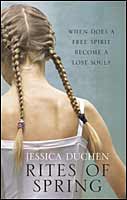
springs out on the cover: “When does a free spirit become a lost soul?”.
On fortune's wheel, the characters nonetheless have a choice: bitter self-destruction,
or to live. Liffy has to choose self-control, or a giddy sense of purity, from
the anorexia that threatens to kill her, or to accept the ballet career she'll
never have “isn't the be all and end all, is it?”. Choose
Life, urged Irvin Welsh, but it isn't just junkies who find it impossible. Music,
or any art form, is a mistress like Stravinsky's score: savage, frightening. glorious.
We can grasp, usually, that successful artists put their real lives second, like
the novel's ever travelling pianist Vladimir. We tend to forget the same agony
faced by those with equal passion and without the luck. At its heart, the novel
(indirectly, but powerfully) understands Benjamin Britten's sadly knowing: “It
is cruel, you know, that music should be so beautiful. It has the beauty of loneliness
and of pain: of strength and freedom. The beauty of disappointment and never-satisfied
love.” The
Rite of Spring dances a girl to death, a sacrifice to please the God of Spring.
Rites of Spring stops a girl dancing, in the end, so she can live, and brings
the two characters who think mostly of nothing but music a child. The will to
live, and the drive for life perpetually to renew itself, courses alongside the
individuals disappointed along the way. What
we want defines our lives. Sometimes we get it, and sometimes not. Private sadnesses
lurk in our shadows, part of reality. There is also something always turning towards
the sun. | | Read
the blog entry on Helen's website here |
|
RITES
OF SPRING - Review on Amazon website - Link
 Sensitive, moving and marvellous 23 July 2006 Sensitive, moving and marvellous 23 July 2006
I read this first in hardback; now I'm buying the paperback for all my friends' birthdays.
I just couldn't put it down. It's not really a book about anorexia, but about the sensitive balance of dynamics within the family and what can happen when they're out of kilter.
Liffy, 13, is an adorable, vulnerable heroine. She and her pretentious mother, bereaved father, lovelorn aunt, and infuriating twin brothers feel like real people who are struggling to cope with what life throws at them, as we all do. And the cats are wonderful.
I found 'Rites of Spring' sensitive, beautifully written, compulsively readable and very moving. One review, quoted in the paperback, compared it to Joanna Trollope, but I'd say it's several cuts above, and incidentally you don't need to know anything about classical music to enjoy it. I hope we'll have lots more from this fascinating writer. (K.Shelley)
|
|
| RITES
OF SPRING
(Review
- Blue Badge Guide Post - February 2006)
In Jessica Duchen’s
novel, out this month, London is more than a backdrop: it is silent witness to
a quintessentially urban family breakdown. Something
is going drastically wrong with Adam and Sasha Levy’s home life in their
rambling
house off the South Circular in East Sheen, a short walk from Richmond
Park where Sunday
afternoons are spent with their daughter and twin boys. In
Waitrose shopping aisles and Queen’s Park sitting rooms, Jessica Duchen delicately
observes the roots of family tension rumbling just below the surface of marriages
in Tony Blair’s Britain. The Levys seem a familiar aspirational couple, steering
a course between hectic, high-powered careers and successful family life. But
Rites of Spring finds the Levys prey to the one thing they can’t cope with
- a family death. With
the lightest touch of irony, Duchen traces each crack in the family’s structure
as it appears - a concert at the Wigmore Hall, a musicians’ party in Hampstead,
an abortive shopping expedition to Harrods, until the whole family slides into
a vacuum pack of self absorbed individuals no longer able to communicate or comprehend
each other in any situation. Not even mobile phone calls or messages ever seem
to get through. Daughter
Olivia, “Liffy”, an uncomprehending thirteen year old and would-be ballerina,
comes off worst in the dysfunctional world her parents have unwittingly created.
Via her musicologist aunt’s specialist interest in Stravinsky, spooky folklore
tales filter into the spaces in her heart and mind vacated by her parents’
virtual withdrawal of care. Duchen pitches us into Adam and Sasha’s hapless
mid-life paths of self-discovery, while they fail to recognise that their beloved
daughter has embarked on a journey through her own rite of bodily self-sacrifice. Jessica
Duchen’s name may be known to the music-loving Blue Badge Guide contingent
as a regular contributor to the Independent and BBC Music Magazine. She has previously
published
biographies of composers Gabriel Faure and Erich Wolfgang Korngold.
But this book, her first foray into fiction, has already been rewarded by a two-book
deal with Hodder and Stoughton.
| Blue
Badge Guide Post
(the magazine of the stringently trained Blue Badge
London tourist guides) | |
|
|
|
RITES
OF SPRING |
 |
(Classical Music Magazine, 17 March 2007) |
'Duchen writes with a rhythm and pace that embrace a tellingly perceptive and articulate portrayal of the nuances of the human condition, richly detailed and yet always fluent...We shall read more from her.' |
|
|
|
| GABRIEL
FAURÉ | |
|
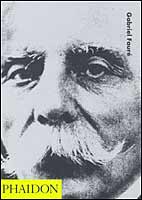
Fauré
himself would probably have enjoyed handling this discreetly sensual paperback,
with its muted silver cover and beautifully designed text on creamy paper. The
Phaidon series on 20th-century composers aims to appeal to the general reader
and music enthusiast. Jessica Duchen's book certainly does this, but goes beyond
that to appeal to, and satisfy, a reader already well-versed in Fauré's
works.
BBC Music Magazine |
|  To
order, click on Picture.
To
order, click on Picture. |
| | BOOK
OF THE MONTH
An intimate portrait of Fauré's life and works entices the reader into
the world of this charming composer. The book should have wide appeal; it is immensely
informative and enjoyable. Jessica Duchen portrays the composer in the context
of his social and political, as well as musical times, rather than focusing on
technical analysis, making it accessible to anyone who would like to further explore
the life of this fascinating composer. This new biography provides a very involving,
wonderful read, and is highly recommended.
Classical
Source.com | |
Jessica
Duchen is fully alive to [Fauré's] value and to the difficulties that have
beset his reputation and performances of his music, and her pleas, couched for
the most part in the kind of literate English which must nowadays be regarded
as exceptional, are clearly grounded not only in a love but in a close knowledge
of his works.
Gramophone | |
|
| | …in
this fascinating biography Jessica Duchen reveals through letters and anecdotal
evidence the undercurrents of passion and individuality otherwise latent in Fauré's
character…The fact that Fauré managed not to be swayed by these strong
influences [Wagner] is perhaps indicative of the innovative and forward-looking
nature of his compositions and personality so splendidly portrayed by Duchen in
this beautifully-constructed biography…Duchen provides a thorough and fascinating
exploration of Fauré's life and work, his personal relationships and in
particular the social, political and economic history of France during this period.
Classical Music Magazine |
| |
| |
|
| |
| To
order, click on Picture. |
|
| | | Inside
London | The
complementary text by Jessica Duchen is both readable and informative and adds
to the book by giving a conceptual framework for the photographic images.'
INscape
|
| | | |
|
|
|
| | |
| |
| ERICH
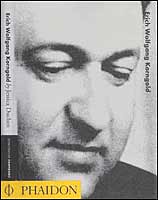
WOLFGANG KORNGOLD | 'It
is an intriguing life story and in Jessica Duchen's highly readable new biography,
the first comprehensive book on the man in English, he emerges as a significant
figure in early 20th-century Austro-German music…Duchen ably conveys the
musical characteristics of all Korngold's major works.'
BBC Music Magazine |
| 
To
order, click on Picture.
| |
|
'…lucid
and persuasive' - Birmingham Post |
|
I
think you did an outstanding job in characterizing my father, relating everything
worth knowing with an astounding degree of accuracy…You have created a lively,
sympathetic portrait, which I, at least, found difficult to put down. Your interest
and your work are greatly appreciated and I can't thank you enough.
Ernst
W. Korngold
| | |
|
|
| |
| |
| |
|